
Crawford Projected and Actual Dates
A projected date is a calculation or eligibility point. An actual release is an event that has occurred. The distinction is vital in a Crawford County case because one date may show when release could first be considered, while the current status still says Prisoner. Parole may be denied or deferred. A disciplinary change, new sentence, hold, or corrected computation may also keep the person confined.
Pretrial detention works differently. A person awaiting trial has not received a final jail or prison sentence from which staff can compute an end date. Bond, dismissal, remand, plea, or another court order controls what happens next. Even after bond is paid, processing and any other hold must be resolved. The court record supplies the legal basis, while the Crawford County Jail record is the better source for the processed release time.
Scheduled versus actual: a calculation shows a possible or legal milestone; release is confirmed by the custodian’s status and release record.
For a sentenced state prisoner, read the OTIS status before any date. “Prisoner” does not show release. “Parolee,” paired with the date paroled, supports release from prison into supervision. “Discharged” and the discharge information show that active MDOC supervision has ended. A county transfer into MDOC custody is not a community release, even though the person is no longer at the Crawford jail.
Find Crawford Projected Release Dates
The correct path starts with custody type. OTIS covers people under Michigan Department of Corrections jurisdiction or supervision. It is not the default source for someone serving a short county sentence or awaiting trial in Grayling. The Crawford court file, jail line, and sheriff record handle those local events. Federal and immigration systems answer separate questions and should not be used to infer a local date.
- Confirm whether the person is at Crawford County Jail, in an MDOC prison, on state supervision, or held by another agency.
- For an MDOC case, open the OTIS offender search. Use the MDOC number when known, or search by name and added identity fields.
- Match the photograph, offense, convicting county, court file number, and sentence. A name alone can select the wrong person.
- Read current status first. Then locate the exact field “Earliest Release Date” and, when present, “Maximum Discharge Date.”
- For a county sentence, obtain the judgment, jail-credit terms, and amended orders from the court, then ask the sheriff for its maintained computation or release record.
- Confirm an actual event through parole or discharge information, a court order, or the custodian’s processed release record.
When an OTIS entry is missing, check spelling, aliases, status filters, and whether the case ever belonged to MDOC. OTIS says discharged information is publicly available for three years after discharge. A set-aside, nonpublic matter, old discharge, or data mismatch can also explain a blank search. For formal proof, use MDOC records or the court and sheriff path described in the Crawford County release-record overview.
Note: A local jail case may never appear in OTIS, while an MDOC result may involve a prison located far outside Crawford County.
Crawford OTIS Release-Date Fields
Michigan’s public projected-date field has one exact label: Earliest Release Date. It is an eligibility or sentence-calculation field. It is not a confirmed departure date. Maximum Discharge Date is a different endpoint that may show the outer end of MDOC control under the record’s current terms. Neither label should be rewritten as “scheduled release” or read without the person’s status.
An OTIS detail can also show name, MDOC number, photograph, aliases, physical identifiers, assigned location, parole or probation dates, discharge information, conviction, county, court file number, sentence date, minimum and maximum sentence, and offense details. Fields vary by record. The public entry carries an accuracy warning and should be checked against MDOC or the court when an exact calculation matters.
| OTIS item | What it establishes | What it does not establish |
|---|---|---|
| Earliest Release Date | The displayed earliest eligibility or calculation point | That release was granted or occurred |
| Maximum Discharge Date | A different sentence or supervision endpoint shown by MDOC | A guaranteed date when all facts will remain unchanged |
| Prisoner | The record still identifies prison status | Community release |
| Parolee and date paroled | Release from prison into MDOC supervision | Discharge from the sentence |
| Discharged | Active MDOC supervision has ended | The exact earlier door-exit time from a county jail |
OTIS should also be separated from a current county-jail check. Crawford County publishes no online custody roster or projected-date tool. Call the jail for present custody, use the court for the controlling judgment, and request the sheriff’s maintained record for the actual county release event.
Crawford Truth-in-Sentencing Rules
Michigan’s modern rule is not a fixed-percentage shortcut. For offenses committed on or after December 15, 1998, the truth-in-sentencing structure generally requires service of the full judicial minimum before parole eligibility. Ordinary good-time or disciplinary-credit awards do not shorten that minimum. Disciplinary time can instead extend the eligibility calculation.
The main modern provisions are MCL 791.233b and MCL 791.234. The first addresses disciplinary time and the modern sentence structure. The second governs parole eligibility and Board jurisdiction. Eligibility only allows the Board to consider release. It does not create a right to parole on that date.
The official disciplinary-time statute is shown below through its Michigan Legislature source. The image anchors the rule to the statute, while the person’s judgment, offense date, and MDOC computation still control the individual result.
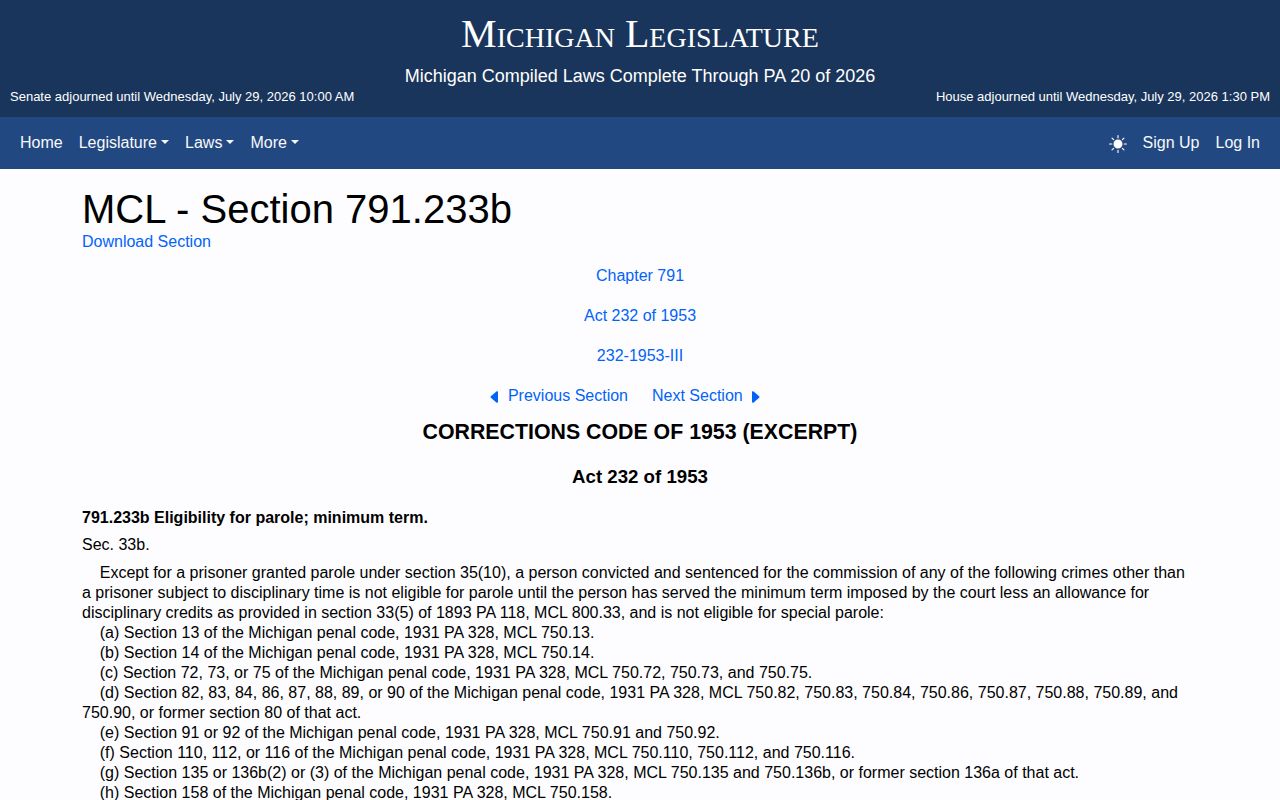
Certain life sentences and statutory exclusions follow distinct rules. Consecutive sentences can also change when the relevant minimum is reached. No sound forecast comes from multiplying the sentence by a fixed percentage. Start with the judgment, identify the governing law by offense date, and obtain MDOC’s calculation when the public field is disputed.
Crawford Older Sentence Credit Rules
Older Michigan sentences can fall under statutory good-time or disciplinary-credit laws that differ from the current scheme. MCL 800.33 contains older good-time provisions. MCL 800.34 addresses a disciplinary-credit framework and exclusions. These laws must be read with the offense date, sentence type, and later statutory changes.
Credit is not a free-standing number that can be added from a generic chart. Some sentences qualify under older rules, while modern truth-in-sentencing terms generally require the full judicial minimum. A new conviction, disciplinary finding, or corrected sentence structure may also change how the department computes the date. Applying an old credit rule to a newer offense can produce a false forecast.
The safer request is for the public sentence-computation sheet or equivalent record. Give MDOC the offender number and identify the conviction and sentence in question. Ask for the calculation, release or discharge authority, and any public final parole decision. If the dispute begins with jail credit or an amended judgment, obtain that court document as well.
Note: Offense date and sentence type select the governing credit law; older Michigan provisions must not be applied to every current prisoner.
Why Crawford Release Dates Change
A calculated date can move for reasons found in both court and corrections records. Some changes alter the sentence itself. Others affect parole eligibility or prevent physical release even after one legal basis has ended. The public date should therefore be treated as a current calculation, not a fixed appointment.
| Factor | Possible effect | Best record to check |
|---|---|---|
| Jail credit | Changes time credited toward the sentence | Judgment, amended order, and MDOC computation |
| Concurrent or consecutive terms | Changes how multiple sentences run together or in sequence | Judgments and sentence computation |
| Resentencing or amended judgment | Replaces or corrects the controlling court terms | Court register and signed order |
| Disciplinary time | Can extend the modern eligibility calculation | MDOC computation and releasable disciplinary record |
| Parole decision | Grant, denial, deferral, or rescission changes the expected path | Final Board decision and OTIS status |
| Another hold or detainer | May lead to transfer instead of community release | Custodian release disposition and receiving-agency record |
| New conviction or violation | Can add custody, alter sentence structure, or affect parole | Court orders, Board record, and updated computation |
A detainer is a request or authority for another agency to take custody. Crawford County Jail sometimes houses people for MDOC, outside counties, and ICE. A person can thus leave the jail on transfer without becoming free in the community. Ask for the receiving agency and the maintained disposition, then use that custodian’s system.
Crawford County-Sentence Date Calculations
Crawford County Jail holds pretrial detainees and people serving county terms of one year or less. OTIS is not the controlling calculator for an ordinary local sentence. Read the signed judgment, the jail-credit provision, any amended sentence, and whether another case or hold applies. The court establishes the legal term. The sheriff processes custody and maintains the release event.
A pretrial case has no sentence-end date. Magistrates may arraign, set bond, and remand the person to jail. Bond can permit release while the case continues, but payment does not prove that processing is complete. A dismissal or new court order may also end one basis for detention while another hold remains. Ask the jail whether the public disposition reflects community release or transfer.
For a sentenced local inmate, use MiCOURT as a public starting point, then use the Crawford County courts portal to reach 87-C District Court at (989) 344-3242 or 46th Circuit Court at (989) 344-3206. Call the jail at (989) 348-4822 through the official Crawford corrections page for present custody. The county FOIA hub provides the route for a formal sheriff booking and release record when the processed date, time, and disposition are needed.
The court and sheriff records answer different parts of the question. A judgment shows the sentence and jail credit. A court order can authorize release. The sheriff record is more likely to show when release or transfer was processed. Keeping those roles separate avoids turning a court date into an unsupported exit time.
Crawford Overcrowding Review Is Judicial
Crawford’s court compliance-officer description adds a local calculation quirk. When the officer receives notice of jail overcrowding, the officer may review inmate files and recommend qualifying people to judges for early release. The judge retains control. This is not automatic good time, a public release calendar, or a percentage reduction that can be applied in advance.
The local compliance-officer description documents the recommendation role. A recommendation alone does not authorize someone to leave. Look for the resulting judicial order and then confirm that Crawford County Jail processed the release. If the jail transferred the person to another custodian, the event is not a community release.
This path also does not replace the sentence laws used for an MDOC prisoner. It concerns local court review in an overcrowding setting. State-prison parole eligibility remains governed by the sentence, Michigan statutes, MDOC computation, and the Parole Board. The same phrase, “early release,” can therefore refer to very different legal processes.
Confirm Crawford Actual Release
Confirmation requires both identity and event. For MDOC, match the offender number, name, photograph, offense, county, and court file. Then look for Parolee status with the actual date paroled, or Discharged status with discharge information. Earliest Release Date alone is not an event. Maximum Discharge Date alone is not proof that supervision ended as forecast.
For Crawford County Jail, call for current custody and request the sheriff’s maintained release disposition when the answer must distinguish release from transfer. Use the court file for the order that authorized the change. When MDOC computation is disputed, request the sentence-computation record and final parole decision through MDOC’s formal records route.
Crawford participation in a public VINELink custody feed has not been verified, so no release alert from that service should be promised. The Crawford notification alternatives explain the verified local Victim Rights and state victim-services routes for eligible notice needs. An alert remains a prompt to check the custodian, not a certified release record.
Note: Confirm status after the displayed date passes; a date without Parolee, Discharged, or a custodian release record remains only a calculation.