
Crawford Parole and Probation Compared
A person on parole has left a state prison while the sentence remains active. The Michigan Parole Board authorizes that move to supervised community status. Probation is imposed by a court as a community sentence. It may include a short jail term, but probation alone does not prove that the person was released from prison. Crawford County divides probation work by case level: the Michigan Department of Corrections administers felony probation, while 87-C District Court handles misdemeanor probation.
That split controls which record to trust. An MDOC parolee or felony probationer can appear in the Offender Tracking Information System, known as OTIS. A misdemeanor probation case belongs in the District Court record and probation office. Neither result, by itself, gives the processed exit time from Crawford County Jail. For that event, the sheriff’s maintained booking and release record is the more direct source.
| Point | Parole | Probation |
|---|---|---|
| Basic meaning | Release from state prison with the sentence still under supervision | A court-ordered community sentence, sometimes with a local jail component |
| Crawford agency | MDOC and the Michigan Parole Board | MDOC for felonies; 87-C District Court for misdemeanors |
| Public starting point | OTIS status, parole date, and assigned location | OTIS for felony probation; court file for misdemeanor probation |
| End of supervision | MDOC discharge information | MDOC discharge or a judge’s Order for Discharge |
- Parole
- Supervised community status after release from a state prison.
- Probation
- A court sentence served in the community under stated conditions.
- Discharge
- The formal end of active supervision, not merely release from a jail or prison.
- Absconder
- A person whom MDOC lists as having lost required contact with supervision.
Verify Crawford Post-Release Supervision
Begin with the sentence type and a firm identity match. The MDOC OTIS search accepts last name, first name, offender number, sex, race, age, offender status, and marks, scars, or tattoos. The offender number is the best search key when known. If it is not known, compare the result’s name, physical details, photograph, conviction, convicting county, and court file number. A similar name is not enough.
The result’s current status matters more than a date viewed alone. “Parolee” means the person is outside prison but remains under MDOC supervision. “Probationer” identifies MDOC-administered probation, which in Crawford generally means a felony case. “Discharged” means active MDOC supervision has ended. OTIS also has separate Parole Absconder and Probation Absconder filters. Those labels allege a lapse in supervision contact; they do not mean the sentence was completed.
- Search OTIS by MDOC number, or use the full name and added identity filters.
- Choose “All” when the status is uncertain. Use Parolees or Probationers only to narrow a known type.
- Open the detail and match the offense, Crawford County or other convicting county, court file, and identifying information.
- Read the current status, parole or probation dates, and assigned location. Do not assume the local office has the file.
- For misdemeanor probation, search the Crawford case through MiCOURT and contact 87-C District Court for the maintained order.
- If the result is unclear or absent, ask MDOC or the court for the actual supervision or discharge record.
A person released only from Crawford County Jail after bond, dismissal, or a short local sentence may never appear in OTIS. In that situation, the court record explains the case and any probation term. The sheriff record confirms the jail release. The broader Crawford County released inmate search path separates those local records from MDOC custody.
Note: OTIS removes discharged information from public view after its stated three-year window, so an empty search is not proof of no supervision.
Crawford Supervision Offices Differ
The local MDOC parole and probation office and the Crawford courts share the county complex at 200 W. Michigan Ave. in Grayling. That shared address can be misleading. The offices serve different people and keep different records. The OTIS assigned location controls for an MDOC parolee or felony probationer. A Crawford conviction, residence, or past jail stay does not guarantee that the Grayling field office supervises the person now.
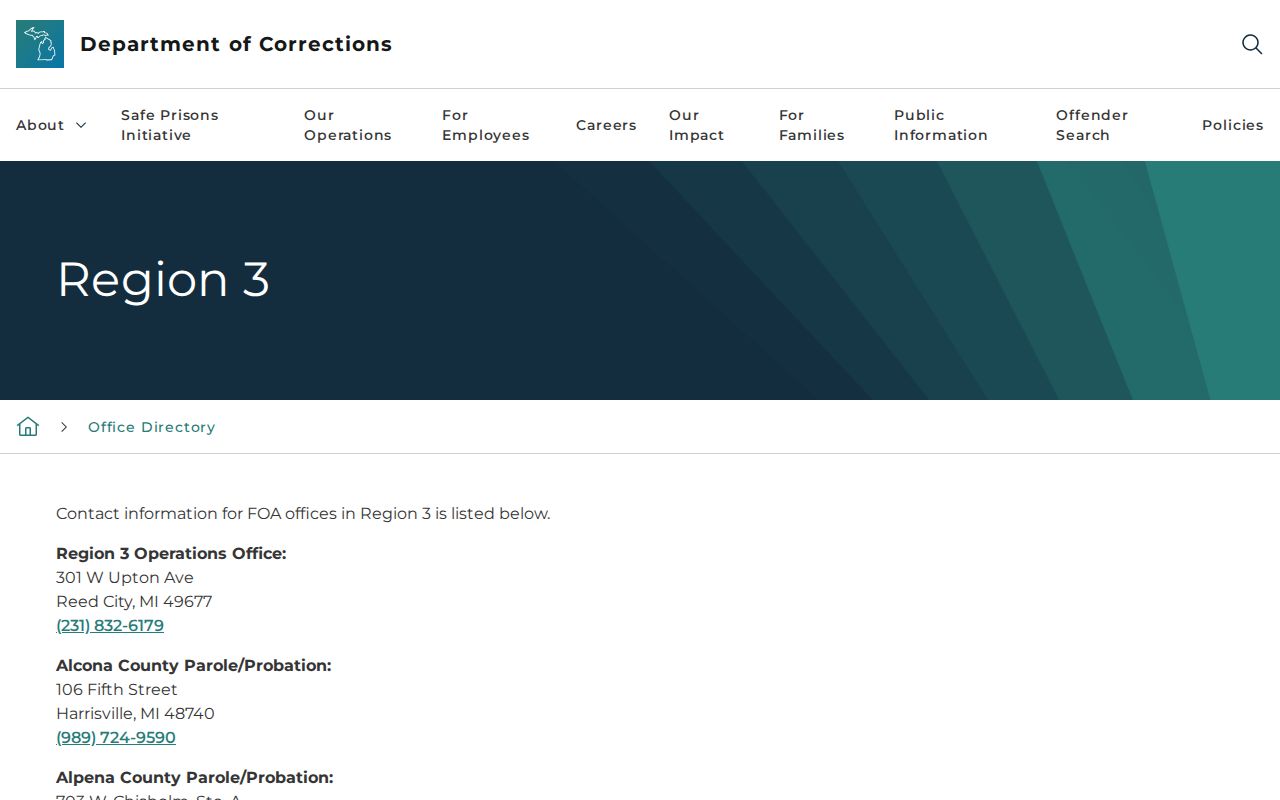
The MDOC Region 3 directory is the official source for the Crawford field office. Crawford County also publishes the 87-C probation-services route for local misdemeanor matters. The screenshot below documents the MDOC office-directory route. It should be paired with the individual OTIS record, since field assignments and specialized caseloads can vary.
MDOC Crawford Parole/Probation
200 W. Michigan Ave.
Grayling, MI 49738
(989) 344-3208
87-C District Court
200 W. Michigan Ave.
Grayling, MI 49738
(989) 344-3242
Call MDOC for state parole or felony probation only after checking the assigned office. Call District Court about a misdemeanor probation case, its conditions, or a filed discharge order. Neither number is the main confirmation line for an ordinary bond release from the county jail.
Crawford Parole Hearing Records
The Michigan Parole Board acts within MDOC. Michigan law gives the Board jurisdiction under MCL 791.234, but eligibility is not a promise of release. Offense date, sentence structure, the judicial minimum, statutory exclusions, and older credit rules can all affect when the Board may act. Certain life terms are governed differently or are not parole eligible.
There is no comprehensive public calendar for every routine interview and no searchable database of all Board votes. MDOC posts event-specific public-hearing notices through Corrections News, often for commutation matters or eligible life cases. A missing news item does not show that no routine review occurred. Search the news page by the person’s name, then request the final decision from MDOC when it is not online.
Possible outcomes include a grant, denial, deferral, request for more facts, continuance, or rescission before release. Later violations can lead to revocation proceedings. Use the exact words in the decision. Even a grant does not prove the person physically left prison. OTIS should later show the actual parole date and Parolee status, subject to MDOC’s warning that online information can lag.
Crawford Absconder and Violation Status
Supervision conditions are set in the individual order. They may govern reporting, travel, treatment, contact, or conduct, but a public summary should not be treated as the person’s full terms. A suspected violation also does not establish a final outcome. MDOC or the court must decide what the record means and what action follows.
OTIS provides Parole Absconder and Probation Absconder status filters. An absconder is someone MDOC alleges has stopped required contact or cannot be located for supervision. It is not the same as discharge, release from all legal control, or a new conviction. A warrant or detainer may exist, but the online label should not be expanded beyond what the agency states.
Do not approach a person based on an absconder result. Verify the current status through MDOC or the appropriate law-enforcement agency.
For misdemeanor probation, the Crawford court register may show a violation filing, hearing, amended conditions, or discharge. For state parole and felony probation, use OTIS and the assigned MDOC office. A notification service is not a substitute for either official record, and Crawford participation in a public VINELink custody feed has not been confirmed.
Note: “Absconder” describes an alleged supervision-contact failure; “discharged” records the end of active supervision and must not be confused with it.
Crawford Supervision Discharge Records
Release from confinement and discharge from supervision are separate events. A parolee has been released from prison but remains under an active state sentence. An MDOC Discharged result is the stronger public sign that state supervision ended. The detail may show discharge information and a Maximum Discharge Date, but every displayed field must be read with current status and verified when exact proof is needed.
Local misdemeanor probation ends through the court. Crawford’s probation material says the probation officer submits a Petition to Discharge after the required conditions are complete. A judge may then sign an Order for Discharge, a term defined in the local court glossary. That order ends probation. It does not prove that the person left Crawford County Jail on the order date, since any jail component may have ended much earlier.
When a formal state record is needed, use MDOC’s records-request route with the MDOC number and ask for existing discharge information. Michigan FOIA, MCL 15.231 et seq., provides access to nonexempt agency records; it does not require MDOC to create a custom answer. Court files follow court access rules, so ask the District clerk for the named order and case number. OTIS states that discharged records remain public for three years after discharge. A set-aside, nonpublic matter, spelling mismatch, or system mismatch can also explain why a record is absent.
Crawford Reentry Programs After Release
The Crawford County Jail lists Peer Recovery Coach, Veterans Justice Outreach, Celebrate Recovery, GED, mental-health programming, Jail Ministry or religious services, and Healthy Relationship meetings. These are named jail programs, not a guarantee of post-release placement. Eligibility, capacity, participation, and any link to community care must be confirmed with the facility or program contact.
One local entry requires special care. The jail’s Community Corrections DBT, CBT, and Seeking Safety listing carries a notice dated January 1, 2026, stating that it is not currently available due to federal funding cuts. DBT and CBT are forms of skills-based therapy. Seeking Safety addresses trauma and substance-use needs. The current notice means none should be promised as an active service.
The official Crawford jail page is the source to recheck before relying on a program. Supervision staff may also direct a person to approved services under the actual parole or probation order. A jail program and a supervision condition are distinct, even when they address the same need.
Crawford Release Property Planning
Crawford publishes no procedure for the return or later pickup of property at release. The jail page says rejected or nonconforming mail is placed in an incarcerated person’s personal property. That statement only explains where such mail goes. It does not identify a release counter, pickup time, identity requirement, or rule for another person collecting property.
Call the 24-hour jail line at (989) 348-4822 before traveling. Ask for the current written policy and what identification or authorization is required. If a person moved to MDOC, another county, or ICE custody, also ask whether property followed the transfer or remained with Crawford. A transfer ends Crawford’s physical custody but is not a community release.
Property and identification questions should be kept separate from supervision status. OTIS and the courts can establish parole, probation, and discharge records. The jail can address property it actually holds. That simple routing avoids treating a mail rule as an invented release process.
Note: Crawford lists a 24-hour jail phone, but it publishes no release-property hours or pickup procedure; confirm the current rule before visiting.